
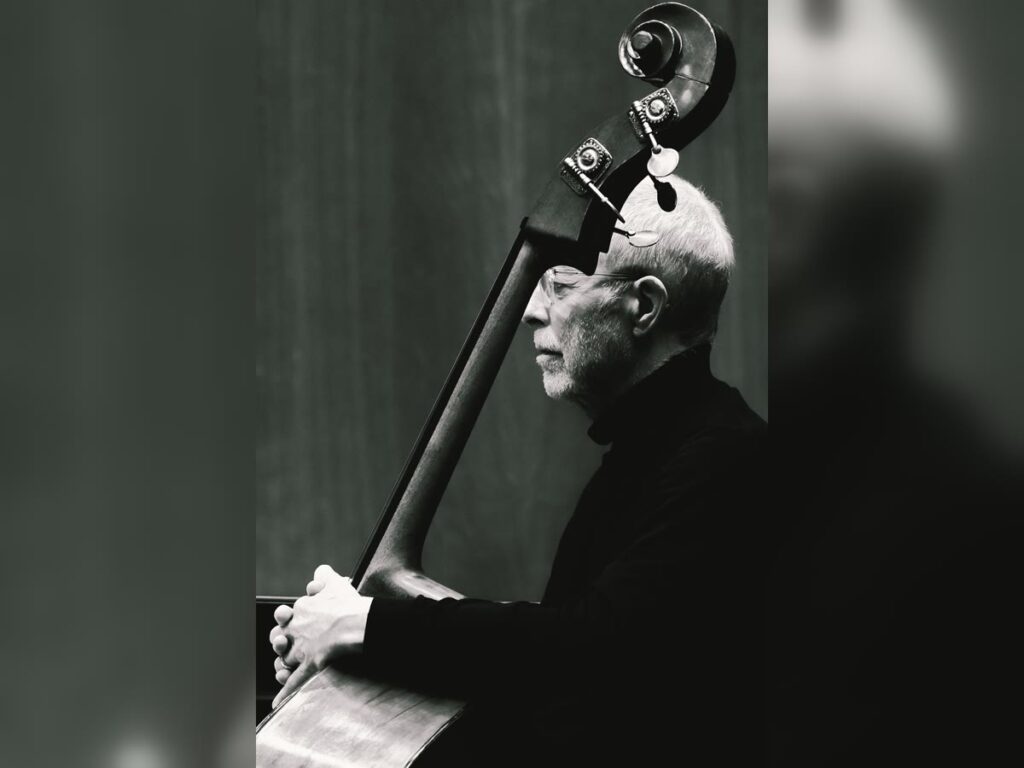
ECM Records has published a long-form entry in its “Timeline” section titled Dave Holland at 80, marking the bassist’s 80th year by tracing a collaboration with the German label that stretches back more than half a century. The label’s editorial text is illustrated with a photograph credited to Harfouche.
From Wolverhampton to Miles Davis
Born in Wolverhampton in 1946, Holland came to London as a teenager, studying double bass while absorbing everything from jazz and contemporary classical music to rock and rhythm & blues. By the late 1960s he was working with leading figures of British jazz before moving to the United States, where an encounter with Miles Davis led to his participation in the sessions for Filles de Kilimanjaro, In a Silent Way and Bitches Brew.
One of ECM’s earliest recording artists
At ECM he was among the label’s first recording artists: his first appearance came on Chick Corea’s A.R.C. in 1971 (ECM 1009), followed that same year by Music From Two Basses with Barre Phillips and Improvisations for Cello and Guitar with Derek Bailey, while Circle – Paris Concert, with Corea, Anthony Braxton and Barry Altschul, documented one of the most exploratory ensembles of the period.
His first album as a leader, Conference of the Birds (1973), brought Sam Rivers, Anthony Braxton and Barry Altschul together in a quartet that combined freedom with a clear sense of compositional purpose; the label calls it a landmark both in Holland’s catalogue and in the history of ECM’s early jazz.
From sideman to composer
His bass is subsequently heard on Tomasz Stańko’s Balladyna, Kenny Wheeler’s Gnu High and Deer Wan, Sam Rivers’s Contrasts, George Adams’s Sound Suggestions and the solo bass statement Emerald Tears. With John Abercrombie and Jack DeJohnette he formed Gateway, whose Gateway, Gateway 2, Homecoming and later In the Moment made room for rock-derived energy, jazz improvisation and an almost conversational freedom.
From the 1980s, quartet and quintet albums including Jumpin’ In, The Razor’s Edge, Seeds of Time and Extensions established him as a major composer; Extensions, recorded in 1989 with Steve Coleman, Kevin Eubanks and Marvin “Smitty” Smith, is singled out as a particularly energetic session. The quintets of the 1990s — Dream of the Elders, Points of View, Prime Directive and Not for Nothin’ — developed a singular ensemble sound built mostly on original writing. Discussing Points of View, Holland recalled Sam Rivers’s advice — “Don’t leave anything out, use it all” — and described his wish to reconcile tradition, blues, free improvisation and contemporary composition.
His groups have served as incubators for a younger generation, among them Steve Coleman, Robin Eubanks and Chris Potter. Beyond his own bands, his work with oud player Anouar Brahem stands out: on Thimar and later Blue Maqams — the latter with Brahem, Jack DeJohnette and Django Bates — Arabic musical traditions, jazz and chamber-like interplay meet without stylistic imposition, and on the more recent After the Last Sky he returns with Bates and cellist Anja Lechner.
Half a century with Manfred Eicher
Looking back in 2003, Holland said: “ECM is a rather special label. That label has really been an ideal form for me. I’m close friends with the head of the label, Manfred Eicher… We’ve developed a very nice and trusting relationship over the years, and I’ve managed to record almost all of my written music with him, and I’m very happy to have it there because they stand behind their catalog.”
His 2025 duo album with John Scofield, Memories of Home, is described by the label as a fluent conversational programme shaped by two intertwined musical lives. The piece closes by noting that the double bass is often called the foundation of an ensemble, while Holland has always understood it as something more — a meeting place that can anchor a group and open it up at the same time; at 80, it adds, his journey is still in full flight.
Source
ECM Records: Dave Holland at 80 (1 October 2026).