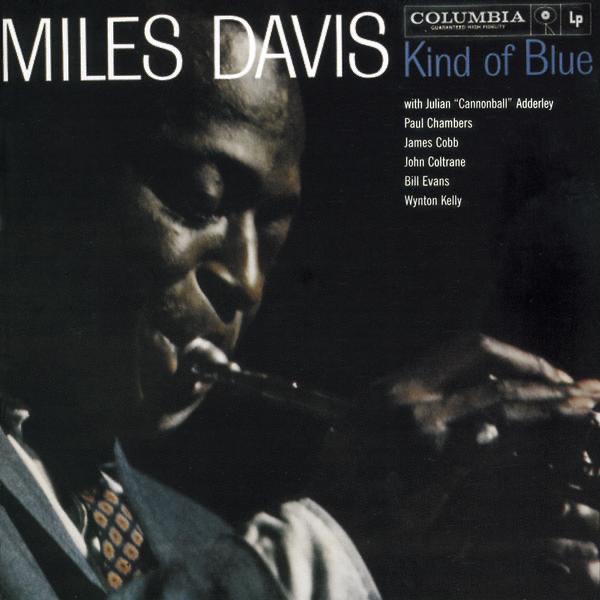
Kind Of Blue is an album by Miles Davis. Released in 2010. Genres: Jazz, Cool Jazz. Released by Columbia. Genre tags. Listen on Spotify, Apple Music.
In the spring of 1959, Miles Davis entered Columbia’s old church studio on 30th Street in New York with six musicians. He gave them only a few sheets of paper with some scales and broad harmonic directions—no melodies and no complete scores. Two days later they left with the best-selling album in jazz history.
That is the legendary opening to Kind of Blue. But legends can keep us from listening to the music.
The first track, “So What,” uses only two chords, D minor and E-flat minor, switching back and forth. As Bill Evans plays those utterly calm introductory notes on the piano, the axis of jazz history begins to tilt. Miles leaves behind bebop’s maze of complex harmony for what he called “modal jazz,” a way of improvising from scales rather than chord progressions. The idea sounds like theoretical subtraction; the emotional effect is multiplication.
Then John Coltrane enters. His tenor solo stays relatively restrained through the first chorus, then bursts open in the second. Notes surge like a tide, so densely you can hardly breathe, yet he never leaves the simple D-minor framework. You are not hearing someone play a scale; you are hearing someone search for something with desperate urgency.
The third track, “Blue in Green,” is said to have been written by Bill Evans, though he and Miles later had a disagreement over the credit. The exchange between piano and trumpet reveals the album’s most vulnerable side: Miles’s muted horn seems to speak to the darkness. Cannonball Adderley’s alto sax adds the album’s only warm color on “All Blues,” where his blues inflections sway as if carried by a light breeze.
Kind of Blue has been analyzed, praised, and canonized to the point of exhaustion. Yet whenever you sit down to really listen, one thing still strikes you: the album does not sound “performed” so much as something that “just happened.” Its calm was not simply the result of careful design, although Miles was an exceptionally shrewd organizer. It came from a group of outstanding musicians letting go of the need for control over two afternoons.
That may be why it has resisted imitation for more than sixty years. Everyone tries to reproduce the scales; no one can reproduce the trust.
Release Date: 2010
Country: US