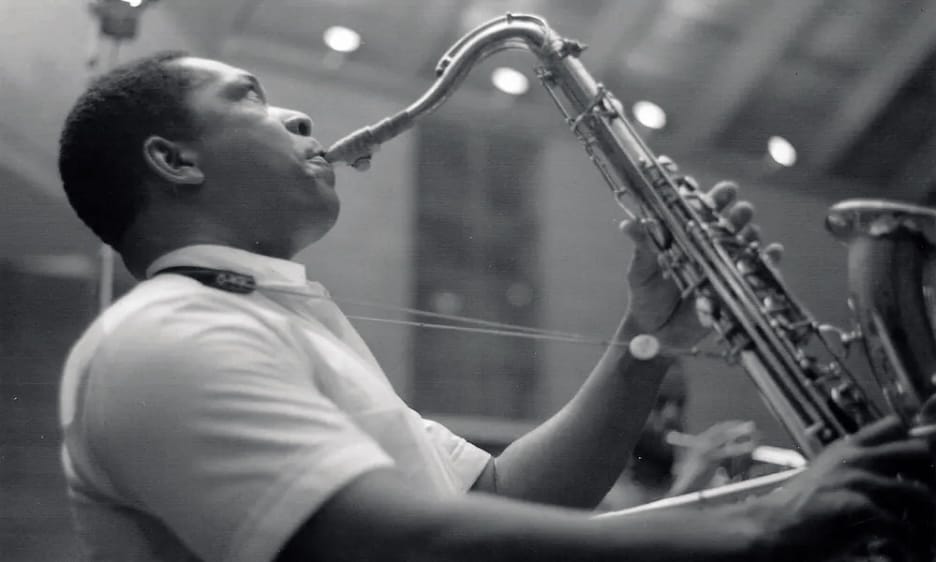
1. Birth and Death Dates September 23, 1926 – July 17, 1967
2. Full English Translation
Introduction Although John Coltrane is often treated as synonymous with jazz, he had a seismic influence on rock from the mid-to-late 1960s onward. His legacy offered more than new sonic material; it fundamentally changed how rock musicians thought about what music could be.
From “My Favorite Things” to Extended Improvisation John Coltrane’s modal reworking of the Broadway standard “My Favorite Things” in 1961 helped catalyze change in rock. His hypnotic, cyclical improvisation, stretching beyond 10 minutes, directly inspired psychedelic rock bands of the era.
-
A Case in Point: The guitar solo in The Byrds’ classic “Eight Miles High” was guitarist Roger McGuinn’s attempt to recreate John Coltrane’s saxophone sound and Indian modes on guitar.
A Love Supreme: Spirituality and Wholeness John Coltrane’s monumental work A Love Supreme influenced rock beyond pure technique, reaching into its very worldview.
-
Structure and Ambition: It showed that a “concept album” could have the grand, symphonic scale of a larger work, helping pave the way for progressive rock.
-
Rock Devotees: Many rock musicians were deeply moved by the album, including Jimi Hendrix, Carlos Santana (who later recorded it with John McLaughlin), Patti Smith, and The Stooges.
Beyond Psychedelia: Power and the Avant-Garde The article argues that John Coltrane’s late free-jazz period, including the album Ascension, had an even more disruptive impact on rock.
-
Noise and Raw Energy: His late-period sound—at times almost shrieking and pushing the instrument beyond its physical limits—became a source of raw power for punk and post-punk. Detroit’s MC5, for example, openly named John Coltrane as a spiritual leader.
-
Breaking Form: He dismantled the conventional verse-chorus structure, and this spirit of free exploration influenced later experimental rock and introspective singer-songwriters such as Joni Mitchell.
Conclusion: A Legacy Across Genres John Coltrane did not change to accommodate rock; rock grew more profound by following his example. He taught rock musicians that music could be more than entertainment—it could be a spiritual rite and a complete release of physical energy.
Key Takeaway John Coltrane’s greatest impact on rock was bringing extended improvisational storytelling, the exotic colors of modal music, and spiritual depth into its musical DNA.