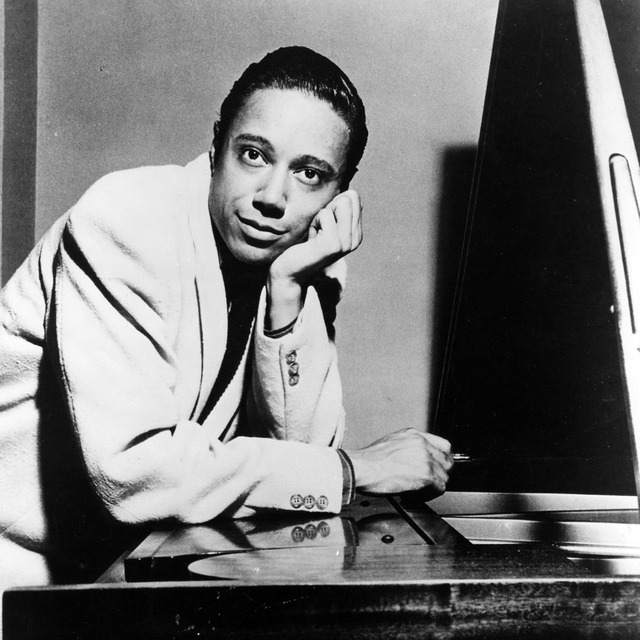
Count Basie is a jazz artist featured on JazzMore. Genres: Jazz, Swing, Big Band, Kansas City Jazz. From United States. Lifespan: August 21, 1904 - April 26, 1984. Explore 50 albums in our catalog, arranged by release date.
William James “Count” Basie (/ˈbeɪsi/; August 21, 1904 – April 26, 1984)
VocalistsCount Basie worked with some of the most famous singers of the 1950s and 1960s, helping keep big-band music alive and enriching his recordings. Jimmy Rushing sang with Basie in the late 1930s. Joe Williams toured with the band and appeared on One O’Clock Jump (1957) and Count Basie Swings, Joe Williams Sings (1956); their version of “Every Day (I Have the Blues)” became a hit. In 1959, Basie recorded Basie/Eckstine Incorporated with Billy Eckstine. Ella Fitzgerald made several memorable recordings with Basie, including Ella and Basie! (1963). Arranged by a young Quincy Jones and performed by the New Testament Basie Band, the album gave her a chance to relax into swing after years of Songbook recordings and touring. She toured with Basie in the mid-1970s, and the two reunited on A Classy Pair (1979), Digital III at Montreux, and A Perfect Match; the latter two were recorded live at Montreux. In addition to Quincy Jones, Basie hired arrangers such as Benny Carter (Kansas City Suite), Neal Hefti (The Atomic Mr. Basie), and Sammy Nestico (Basie–Straight Ahead).
Frank Sinatra first recorded with Basie on Sinatra–Basie in 1962. They worked together again on the 1964 studio album It Might as Well Be Swing, arranged by Quincy Jones. Jones also arranged and conducted the 1966 live album Sinatra at the Sands, recorded during Sinatra’s engagement with Count Basie and his orchestra at the Sands Hotel in Las Vegas. In May 1970, Sinatra and Basie performed at London’s Royal Festival Hall in a benefit for the National Society for the Prevention of Cruelty to Children. Sinatra later recalled: “I had a strange feeling those two nights might have been the greatest moments of my life. The performances were a great success and very exciting.” [80]
Basie also recorded with Tony Bennett in the late 1950s. Their joint albums included In Person and Strike Up the Band, and they toured together, including a performance at Carnegie Hall. Basie also recorded with Sammy Davis Jr., Bing Crosby, and Sarah Vaughan. One of his great regrets was never recording with Louis Armstrong, although they shared the stage several times. [81] In 1968, Basie and his band recorded the album Manufacturers of Soul with Jackie Wilson. [82]Legacy and Honors
was an American jazz pianist, organist, bandleader, and composer. In 1935, he formed the Count Basie Orchestra and took it to Chicago for a long engagement in 1936, where the band made its first recordings. He led the orchestra for nearly 50 years and introduced many innovations, including two “split” tenor saxophone sections, an emphasis on the rhythm section and big-band improvisation, the use of arrangers to broaden the band’s musical style, and his own minimalist piano approach.
Under his leadership, many musicians came to prominence, including tenor saxophonists Lester Young and Herschel Evans; guitarist Freddie Green; trumpeters Buck Clayton and Harry “Sweets” Edison; trombonist Al Grey; and singers Jimmy Rushing, Helen Humes, Dennis Rowland, Thelma Carpenter, and Joe Williams.
As a composer, Basie is known for jazz standards such as “Blue and Sentimental,” “Jumpin’ at the Woodside,” and “One O’Clock Jump.”
The Count Basie Theatre in Red Bank, New Jersey
Basie introduced big-band music to generations of listeners and left a far-reaching repertoire. People who worked with him remembered him as humble, easygoing, full of life, humorous, and always passionate about music. In his autobiography he wrote, “I think the band really swings when it plays easily, like cutting butter.”
The Count Basie Theatre, a former property on Monmouth Street converted into a live-performance venue in Red Bank, New Jersey, and Count Basie Field are named after him. He received an honorary doctorate from Berklee College of Music in 1974.
Mechanic Street, where he grew up with his family, has been given the honorary name Count Basie Way. In 2009, Edgecombe Avenue and West 160th Street in Manhattan’s Washington Heights neighborhood were renamed Paul Robeson Boulevard and Count Basie Place. The corner building at 555 Edgecombe Avenue, also known as the Paul Robeson Residence, is a National Historic Landmark where Basie also lived.
Basie was inducted into the New Jersey Hall of Fame in 2010 and the Blues Hall of Fame in 2019. WordPress 3.7, released in October 2013, was code-named “Count Basie.” Asteroid 35394 Countbasie, discovered by astronomers at Kiso in 1997, was named after him. The Minor Planet Center published the official naming citation on November 8, 2019 (MPC 118220). Basie’s star on the Hollywood Walk of Fame is at 6508 Hollywood Boulevard in Hollywood, California.
Explore 50 albums and recordings, arranged by release date.


Explore other jazz artists who share genre tags with Count Basie.