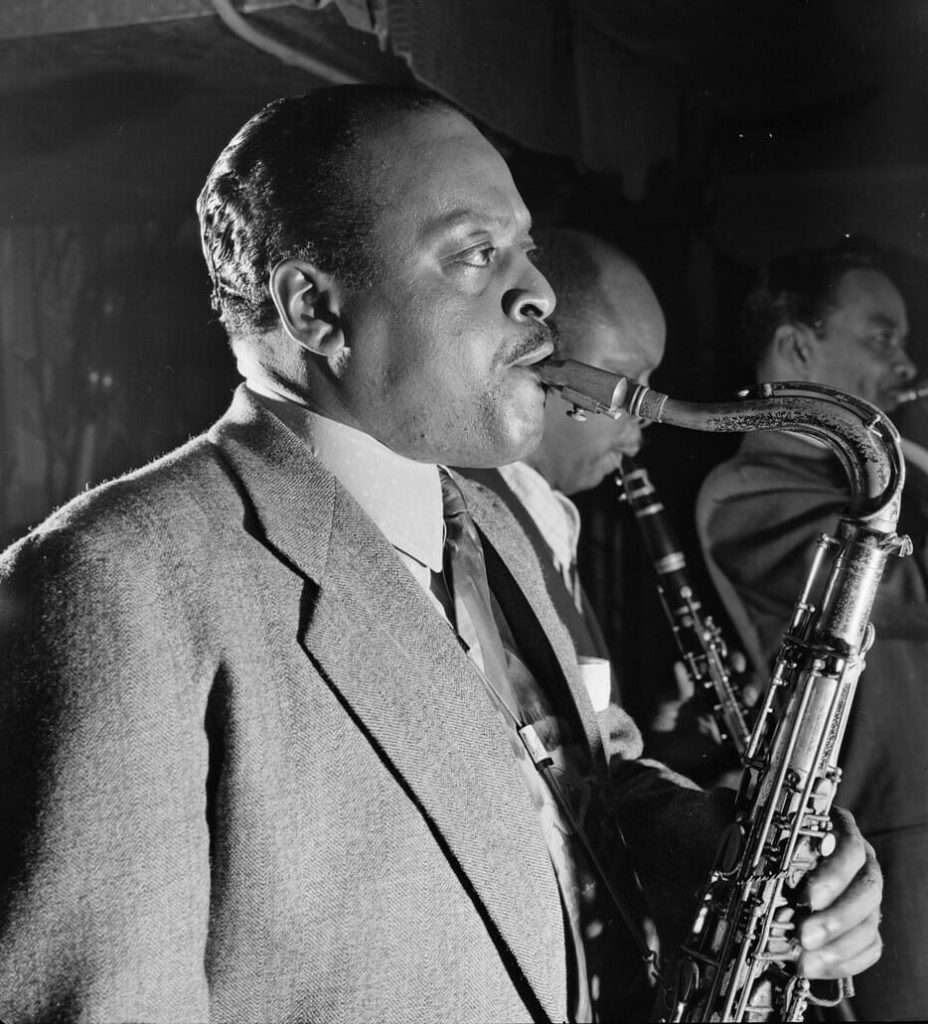


Benjamin Francis Webster (March 27, 1909 – September 20, 1973) was an American jazz tenor saxophonist. He performed in the United States and Europe and recorded with many artists, including Duke Ellington, Billie Holiday, and Johnny Hodges.
Webster was born in Kansas City, Missouri. He studied violin, learned blues piano from Pete Johnson, and studied saxophone with Bud Johnson. He performed with Lester Young in Young’s family band, recorded with Blanche Calloway, and joined Benny Moten’s orchestra, appearing alongside Count Basie, Hot Lips Page, and Walter Page. In the 1930s, he played in bands led by Willie Bryant, Benny Carter, Cab Calloway, Fletcher Henderson, Andy Kirk, and Teddy Wilson.
From 1940, Webster was a soloist with Duke Ellington’s orchestra and recorded “Cotton Tail.” He considered the orchestra’s alto saxophonist Johnny Hodges a major influence. In 1989, Gunther Schuller wrote that Hodges had led Webster away from his earlier Coleman Hawkins-inspired style. Webster was close to Ellington band newcomers Jimmy Blanton and Billy Strayhorn.
Webster’s temperament, however, made him difficult for most of the band and Ellington himself to deal with. Mercer Ellington recalled that his father and the saxophonist argued whenever they were in the same room. Webster cried when he heard that Blanton had died, but, as baritone saxophonist Harry Carney remembered, “after a drink or two, he changed.” Webster left the band in 1943. One story says that, among his last acts as an Ellington band member, he slashed one of Ellington’s sports jackets with a razor. Clark Terry said Webster left after slapping Ellington.
Webster worked on New York’s 52nd Street, frequently recording as both a leader and a sideman. During this period he worked with Raymond Scott, John Kirby, Bill DeArango, Sid Catlett, Jay McShann, and Jimmy Witherspoon. In 1948, he briefly returned to Ellington’s orchestra for a few months.
In 1953, he recorded The Consummate Artistry of Ben Webster (later known as King of the Tenors) with pianist Oscar Peterson, who remained an important collaborator for the next decade. Webster toured and recorded with Peterson, trumpeter Harry “Sweets” Edison, and others through Jazz at the Philharmonic. In 1956, he recorded an album with pianist Art Tatum. On December 16, 1957, he made The Hunt with Coleman Hawkins alongside fellow tenor saxophonist Coleman Hawkins.
In the late 1950s, Webster formed a quintet with Gerry Mulligan that frequently played at the Renaissance Club in Los Angeles. In 1959, the quintet—with pianist Jimmy Rowles, bassist Leroy Vinnegar, and drummer Mel Lewis—recorded Gerry Mulligan Meets Ben Webster.
In late 1964, Webster moved to Europe and performed as he pleased. He lived in London, Scandinavia, and Amsterdam before settling in Copenhagen in 1969. In 1971, he reunited with Duke Ellington and the orchestra for several performances in Copenhagen. He also made a live recording in France with Earl Hines.
In September 1973, Webster suffered a stroke in Amsterdam and died on September 20. His body was cremated in Copenhagen, and his ashes were buried at Assistens Cemetery.
Webster’s private collection of jazz recordings and memorabilia is held at the University Library of Southern Denmark. He played the same saxophone from 1938 until his death and stipulated in his will that it should never be played again. The instrument is now on display at the Institute of Jazz Studies at Rutgers University. A street in Copenhagen is also named Ben Webster Vej in his honor.
After Webster’s death, Billy Moore Jr. and the estate’s trustees established the Ben Webster Foundation. It was formally approved in 1976 to support jazz in Denmark. The foundation uses Webster’s annual royalties to fund musicians in Denmark and the United States, and awards the prestigious Ben Webster Prize each year to an outstanding young musician. Its board, made up of Webster’s close friends and admirers, oversees his artistic rights and the reissue of his recordings.
Explore other jazz artists who share genre tags with Ben Webster.