
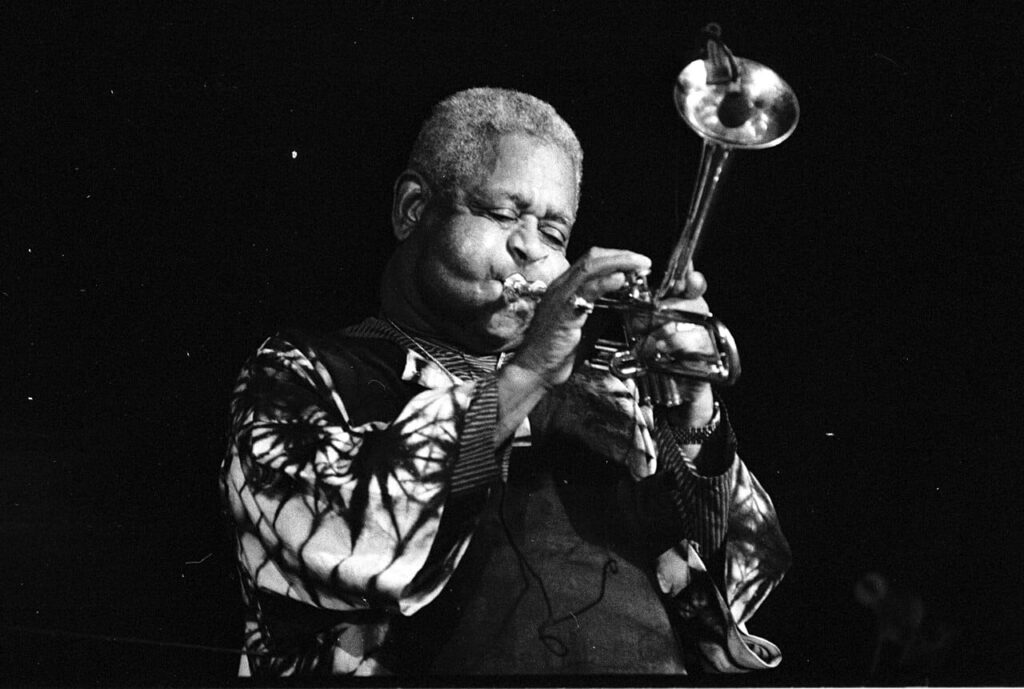
Dizzy Gillespie is a jazz artist featured on JazzMore. Genres: Jazz, Big Band, Latin Jazz, Bebop, Afro-Cuban Jazz. Lifespan: October 21, 1917.
Building on the musicians who came before him, we arrive at one of jazz history’s greatest characters and teachers—Dizzy Gillespie (1917–1993)。
If Charlie Parker was the soul of bebop, Dizzy was itsbrain, diplomat, and evangelist. He combined astonishing technique with a rare gift for passing complex musical ideas on to younger players.
Revolutionary Partner: He helped conceive and advance the bebop revolution alongside Charlie Parker. Dizzy’s deep understanding of harmony—especially the tritone substitution—gave the music much of its theoretical foundation.
First Bebop Recordings: In 1944, he took part in what is widely considered the first bebop recording session, led by Coleman Hawkins. His compositions “A Night in Tunisia,” “Salt Peanuts,” and “Groovin’ High” became jazz cornerstones.
Rhythmic Fusion: Gillespie had a deep sensitivity to rhythm. In 1947, he brought Cuban percussionist Chano Pozo into his band, helping pioneerLatin jazz. “Manteca” fused bebop’s complex harmony with the raw energy of Afro-Cuban rhythm.
Big-Band Breakthrough: While many bebop musicians turned to small groups, Gillespie successfully led several large bebop bands, showing that this forward-looking music could also have a grand scale.
Cultural Ambassador: He was the first jazz musician to lead overseas cultural tours on behalf of the U.S. State Department, performing across the Middle East and Latin America.
A Presidential Run: In 1964, he jokingly announced a run for U.S. president. He proposed renaming the White House the “Blues House” and appointing Miles Davis as CIA director. The episode captured his humor, fearlessness, and willingness to engage with public life.
A Generous Mentor: Known for his generosity, Gillespie discovered and encouraged many younger musicians, including Cuban trumpet virtuoso Arturo Sandoval.
Final Years: He died of pancreatic cancer in 1993, aged 75.
The Upturned Trumpet: The bell of his trumpet pointed upward at a 45-degree angle. The change followed an accident when someone stepped on his horn, but Gillespie found that the new angle helped him hear himself better. It became his visual trademark.
Puffed Cheeks: When he played, his cheeks ballooned like a bullfrog’s. Although this is discouraged in traditional trumpet training, Gillespie turned it into part of his singular sound and image.
Signature Style: Beret, thick-rimmed glasses, and goatee: the look became an enduring image of bebop cool around the world.
Virtuosity with Humor: His playing moved at remarkable speed, full of astonishing high notes and complex rhythmic leaps, yet it never felt heavy. It always carried Dizzy’s wit and sense of fun.
Scat Singing: He was also a great scat singer, using his voice to imitate the intricacies of a trumpet solo.
In Summary:Dizzy Gillespie was the“sun”of the jazz world. With his warmth and humor, he cleared away bebop’s reputation for being aloof and difficult, helping audiences around the world fall in love with the music. He brought technique, theory, and entertainment together like few others.
A Personal Connection: You may remember thatClifford Brownreceived a personal visit and encouragement from Gillespie while recovering from an early car accident. Dizzy was more than a musician; he was one of modern jazz’s pillars.
Explore other jazz artists who share genre tags with Dizzy Gillespie.